
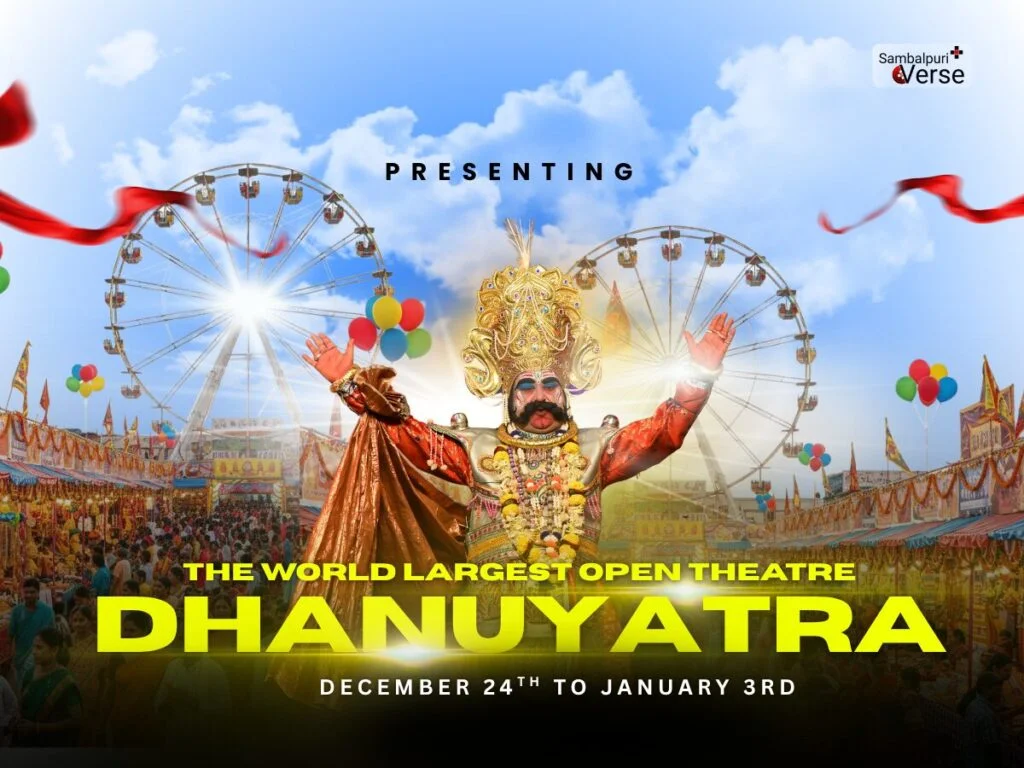

Bargarh Dhanu Yatra 2026-27 Introduction
Bargarh Dhanu Yatra 2026–27, known as the world’s largest open-air theatre, will be celebrated from December 28, 2026, to January 7 (2027) in Bargarh, Odisha. This unique 11-day festival brings the timeless story of Lord Krishna and King Kansa to life, turning Bargarh into the mythological Mathura Nagri.
Unlike a regular stage performance, the entire town becomes part of the festival. Bargarh represents Mathura, while Ambapali becomes Gopapura, creating a living backdrop for the story of Krishna’s childhood, Kansa’s royal court and the eventual Mathura Vijay. Streets, public spaces and different local areas come alive with performances, making Bargarh Dhanu Yatra a remarkable celebration of mythology, folk culture and community participation.

Visitors can witness key events like the inauguration ceremony at Rangamahal, the birth of Lord Krishna at Samaleswari Mandap, Vasudeva’s journey to Goppur, Balya Leela depicting Krishna’s childhood exploits, and the grand finale featuring Kansa’s defeat. One of the festival’s highlights is the Kansa Darbar at Raj Darbar in Hatpada, where daily court sessions and reenactments of Kansa’s royal decrees take place, typically in morning and evening sessions.
The festival spreads across 22 stages within a 8 km radius, offering a mesmerizing theatrical experience for locals and tourists alike. For travelers, it is recommended to book accommodation in advance due to high visitor turnout, use nearby transport hubs like Raipur Airport or rail connections, and enjoy local Sambalpuri cuisine while respecting cultural traditions. Staying updated on the official schedule ensures you catch all key performances and events.
Bargarh Dhanu Yatra is not just a festival but a unique cultural journey that celebrates Odisha’s rich heritage, making it a must-visit for history buffs, theatre lovers, and festive travelers.
Overview of Bargarh Dhanu Yatra 2026-27
The Dhanuyatra at Bargarh is the oldest and most renowned of its kind. Every year, during the month of Pausa (December), it is celebrated for eleven days, beginning on the 5th day of the bright fortnight and continuing until the full moon. On this grand occasion, the town of Bargarh transforms into the city of Mathura, the Jeera River symbolizes the sacred Yamuna, and Ambapali, located across the river, becomes Gopapura.


Dhanuyatra is a place where everyone, from commoners to elites, comes together. This eleven-day extravaganza places Bargarh prominently on India’s cultural map, aligning it with the finest traditions of Odisha’s heritage and culture. The festival spans over 5,834 sq.km, encompassing both a village and a town. The cast is extensive, with nearly every villager taking an active role. Throughout the eleven days, the people of Bargarh follow the orders of King Kansa rather than the district administration, reflecting the festival’s deep-rooted communal spirit.

The festival is a remarkable synthesis of stage, theatre, and cinema, conducted in the eleven days preceding Pous Purnima. Unlike traditional stage plays or cinema, the acts unfold across different locations as described in the Puranas, requiring visitors to move from place to place to experience the drama live. The Raj Darbar serves as a hub for all types of cultural performances, from classical music and dance to folk dances, puppet shows, dummy horse dances, devotional performances, and innovative artistic presentations.
A Short History of Bargarh Dhanu Yatra
The World famous Bargarh Dhanu Yatra originated in 1948 and has earned global recognition, not only because of the separate and movable stages used to enact the story, but also due to the whole-hearted participation of the local populace. This unparalleled involvement justifies calling the festival “the greatest play in the world,” performed on the largest open-air theatre.
Over the years, the festival has grown bigger and now includes colorful processions, cultural shows, and interactive performances. Every year, local artists, villagers, and communities actively participate, ensuring that the festival retains its authentic folk charm.
Attending the Bargarh Dhanu Yatra 2026–27 is not just about watching performances; it is about experiencing the culture, tradition, and devotion of Western Odisha firsthand.
Transformation of Bargarh & Ambapali During Dhanu Yatra
Every year, as the Pousa Sukla Sasthi approaches, the town of Bargarh undergoes a magical transformation. Streets, squares, and even small lanes are decorated with vibrant colors, banners, and traditional motifs. The air is filled with excitement and anticipation, with locals and artisans working tirelessly to prepare for the grand event. Main thoroughfares are adorned with decorative torans (floral arches), and makeshift stages are erected at strategic locations, turning everyday streets into theatres of myth and performance.
Table: Key Locations and Roles
| 📍 Location | 📝 Info | 🗒️ Notes / Remarks |
|---|---|---|
| Mathura Nagar, Bargarh | Kansa’s capital | Main hub for political drama and Raj Darbar |
| Gopapur, Ambapalli | Krishna’s village | Childhood exploits and Bal Leela |
| Raj Darbar, Hatpada | Royal court | Key performances, climax scenes |
| Rangamahal, Nishamani School | Cultural stage | Folk dances, music, side performances |
| Brundavan Tota, Ambapalli | Raas Leela | Krishna-Gopis devotional dance |
| Arrival of Akrura | Procession | Chariot procession inviting Krishna-Balaram |
| Biday Mandap, Ambapalli | Farewell | Emotional farewell of Krishna and Balaram |
| Kaliya Dalan, Fakira Bandh | Serpent fight | Krishna defeats Kaliya Naga |
| Bastra Haran, Ambapalli | Clothes stealing | Playful act with Gopis’ clothes |
| Nabakeli, Manabandha | Water sports | Krishna-Balaram’s water games |
| Jamalarjun Bhanjan, Shiva Temple | Devotional acts | Spiritual and divine scenes |
| Karagar, Samaleswari Temple | Prison scene | Devaki-Vasudeva imprisoned; Krishna born |
| Marriage Mandap, Ramaji Temple | Wedding | Devaki & Vasudeva marriage scene |
| Muni Ashram, Govindapali | Sage acts | Spiritual guidance and rituals |
| Yamuna River, Jeera River | River crossing | Sacred crossing; Raas Leela along banks |
| Meeting with Rajak, Khajurkanta | Exoneration | Krishna absolves villagers of sins |
| Kubuja Uddhar, Mukteswar Temple | Rescue | Krishna rescues Kubuja from danger |
Note: All locations and events mentioned are based on the traditional Bargarh Dhanu Yatra route and schedule. Timings, sequences, and performances may vary slightly each year. Visitors are advised to plan their visit accordingly.
The river Jira, which usually flows quietly, transforms into the dramatic Yamuna of Mathura, complete with temporary bridges, decorated boats, and small platforms for enactment of key river scenes. Across the river, the village of Ambapali becomes Gopapura, meticulously decorated with colorful fabrics, traditional huts, and mango orchards representing Brindavan. Even small ponds and water bodies are prepared to serve as Kalindi Sarovara, giving life to the river scenes of Krishna Leela.
📍 Mathura Nagar – Bargarh Town
Mathura Nagar represents the central hub of Bargarh Dhanu Yatra. The town transforms into the capital of King Kansa, hosting the royal court, political plotting, and major dramatic sequences. It serves as the heart of all festivities, bringing together actors and visitors alike.
📍 Gopapur – Ambapalli Village
Gopapur, located in Ambapalli village across the Jeera River, symbolizes Krishna’s childhood village. Key Leela events, including his playful exploits and divine mischief, are enacted here. The pastoral setting provides an immersive backdrop for the devotional and cultural performances of the festival.
📍 Raj Darbar – Hatpada, Bargarh
The Raj Darbar at Hatpada is the central stage for King Kansa’s political dramas. It hosts daily royal sessions, edicts, and the climactic Kansa Badha. Visitors gather here to witness critical plot points, court intrigues, and the grand finale of the Yatra.
📍 Rangamahal – Nishamani High School Ground
Rangamahal, located at Nishamani High School ground, is the secondary performance venue. It accommodates cultural shows, folk dances, puppet performances, and smaller dramatic acts. This lively hub complements the main Raj Darbar events, providing continuous entertainment throughout the festival’s eleven days.
📍 Brundavan Tota – Ambapalli Village
Brundavan Tota, set amidst mango and guava groves in Ambapalli village, is the serene stage for Krishna’s playful childhood scenes. It hosts episodes of Raas Leela and other pastoral sequences, showcasing the blend of nature and mythological storytelling during the festival.
📍 Arrival of Akrura – Brundavan Field, Gopapur
The Arrival of Akrura occurs at Brundavan field in Gopapur. This grand procession symbolizes the invitation of Krishna and Balaram to participate in the Dhanu Yatra. The event involves elaborate decorations, local participation, and is a highlight for both devotees and tourists.
📍 Biday Mandap – Ambapalli Chhak
Biday Mandap, located at Ambapalli Chhak, represents the farewell stage of the narrative. Krishna and Balaram bid goodbye to their foster parents and friends before traveling to Mathura. The ritualized farewell combines devotion, emotion, and dramatic performance, deeply engaging the audience.
📍 Kaliya Dalan – Fakira Bandh, Ambapalli Village
Kaliya Dalan, situated at Fakira Bandh in Ambapalli, is the stage for Krishna’s encounter with the serpent Kaliya. This dramatic episode highlights Krishna’s divine power, courage, and heroism, captivating visitors with a mix of mythology, storytelling, and ritualized performance.
📍 Bastra Haran – Ambapalli Village
Bastra Haran is enacted in Ambapalli village, illustrating the playful episode of Krishna stealing the clothes of bathing Gopis along the riverbank. This lighthearted yet symbolic sequence conveys moral lessons while adding humor, joy, and dynamic interaction between the actors and audience.
📍 Nabakeli – Manabandha, Bargarh Town
Nabakeli, performed at Manabandha in Bargarh, showcases water sports and playful interactions of Krishna and the Gopis. The lively spectacle combines physical performance, devotion, and theatrical skill, drawing large crowds and offering an immersive experience along the town’s symbolic riverbanks.
📍 Jamalarjun Bhanjan – Shiva Temple, Ambapalli
Jamalarjun Bhanjan is enacted at the Shiva Temple in Ambapalli village. This devotional performance features sequences of divine exploits and spiritual lessons, blending mythology, culture, and ritual dance. The sacred setting adds depth and authenticity to the festival experience.
📍 Karagar (Jail) – Samaleswari Temple, Taliapada, Bargarh
The Karagar (Jail) at Samaleswari Temple, Taliapada, serves as the confinement site for Devaki and Vasudeva after Kansa learns of the divine prophecy. The stage portrays suspense, divine intervention, and Krishna’s miraculous birth, forming a pivotal turning point in the festival narrative.
📍 Marriage Mandap – Ramaji Temple, Talipada, Bargarh
Marriage Mandap, located at Ramaji Temple, Talipada, represents the ceremonial wedding of Devaki and Vasudeva. This stage depicts ritualized nuptial sequences with traditional music, dance, and ceremonial attire, setting the foundation for the unfolding mythological drama across Bargarh and Ambapalli.
📍 Muni Ashram – Govindapali, Bargarh
Muni Ashram in Govindapali village offers a serene backdrop for sage-led sequences, philosophical discussions, and meditative acts. These scenes provide spiritual depth, reflect cultural heritage, and connect devotees and visitors to the moral and ethical essence of Krishna’s stories.
📍 Yamuna River – Jeera River, Bargarh
The Jeera River, flowing between Bargarh and Ambapalli, symbolizes the sacred Yamuna. Key episodes such as Krishna’s transfer to Gopapur, Raas Leela, and river crossings occur here. The river acts as a natural boundary and integral part of the festival’s dramatic geography.
📍 Meeting with Rajak – Khajurkanta (Khajurtikra), Bargarh
Meeting with Rajak, at Khajurkanta in Bargarh, depicts Krishna exonerating local villagers from their sins. This stage combines moral instruction, humor, and divine intervention, reinforcing the ethical and social messages embedded in the Dhanu Yatra’s epic narrative.
📍 Kubuja Uddhar – Mukteswar Temple, Gourpada Chhak, Bargarh
Kubuja Uddhar, near Mukteswar Temple at Gourpada Chhak, enacts the rescue of Kubuja, the hunchbacked man, by Krishna. This sequence demonstrates compassion, heroism, and divine grace, serving as a memorable event within the festival’s rich tapestry of mythological storytelling.
Bargarh Dhanuyatra Daily Programs time table
The Dhanu Yatra unfolds over 11 days, with strict adherence to the chronological progression of the narrative, though performers often improvise within the story framework.
Afternoon and Evening Programs
- Afternoon Cultural Processions (≈2:00 PM): Various artist groups participate in vibrant street processions that lead to the Raj Darbar at Hatpada.
- Raj Darbar Commencement (≈7:00 PM): The principal ceremonial session of Kansa’s court, showcasing political machinations, drama, and mythological narratives.
- Rangmahal Performances (≈6:00 PM onwards): Cultural shows run concurrently, offering supporting performances and entertainment outside the main Raj Darbar stage.
Kansa’s Nagar Bhraman (City Patrol)

A unique feature of the Dhanu Yatra is the interactive Nagar Bhraman, where Kansa’s actor patrols the streets of Mathura Nagari:
- Dynamic daytime performance: Spanning the daylight hours, the King engages with visitors and townspeople.
- Public interaction and authority: Kansa issues symbolic edicts, conducts mock trials, and levies fines, emphasizing total immersion in theatrical reality.
- Visitors are encouraged to participate and experience the King’s temporary sovereignty.
Table: Daily Festival Program Overview
| Event | Typical Daily Time | Venue/Area | Visitor Experience Tip |
|---|---|---|---|
| Nagar Bhraman (Kansa Patrol) | Daytime hours | Streets of Mathura Nagari | Prepare for spontaneous interactive drama; join the King’s procession |
| Cultural Processions | Afternoon (~2:00 PM) | Mathura Nagari Streets | Observe vibrant street artists and cultural troupes |
| Kansa Raj Darbar | Evening (~7:00 PM onwards) | Raj Darbar (Hatpada) | Witness core political and mythological drama |
| Rangmahal Programs | Evening/Night (~6:00 PM onwards) | Lokmandap Ground | Enjoy diverse cultural performances alongside Raj Darbar |
Bargarh Dhanu Yatra 2025–26 Schedule for Bargarh Dhanu Yatra
The Bargarh Dhanu Yatra is a spectacular 11-day open-air theatre festival, bringing to life the legendary exploits of Lord Krishna. Every day unfolds a unique chapter of the story, blending devotion, drama, and community participation. Here’s the complete day-wise narrative:
Bargarh Dhanu Yatra 2026–27: Day-Wise Schedule
| Day | Major Event / Story | Date |
|---|---|---|
| Day 1 | Inauguration and beginning of Dhanu Yatra | December 28, 2026 |
| Day 2 | Devaki and Vasudeva’s story and Krishna Leela | December 29, 2026 |
| Day 3 | Kansa’s royal court and Krishna’s early childhood | December 30, 2026 |
| Day 4 | Krishna’s childhood Leela in Gopapura | December 31, 2026 |
| Day 5 | Krishna Leela and major mythological episodes | January 1, 2027 |
| Day 6 | Kansa’s court and the growing conflict with Krishna | January 2, 2027 |
| Day 7 | Krishna’s journey towards Mathura | January 3, 2027 |
| Day 8 | Mathura Vijay and events leading towards Kansa’s defeat | January 4, 2027 |
| Day 9 | Krishna and Kansa’s confrontation moves closer | January 5, 2027 |
| Day 10 | Final events before Kansa Badha | January 6, 2027 |
| Day 11 | Kansa Badha and Dhanu Yatra Finale | January 7, 2027 |
Important: The above table should be treated as a story-based day sequence, not as the officially confirmed 2026–27 performance timetable. The official festival dates are December 28, 2026, to January 7, 2027. Exact event timings, performance locations and venue-wise programme details should be updated once the official 2026–27 Dhanu Yatra programme is published.
Day 1: Inaugural Procession and Rise of Tyranny
The festival opens with the grand inaugural procession of King Ugrasen from Samaleswari Temple to the Raj Darbar, the main stage erected for the Yatra. The wedding of Kansa’s sister, Devaki, with Vasudev, takes place at the Radhakrishna Temple. Following this, Kansa dethrones his father, Ugrasen, and assumes kingship. Soon, he hears a heavenly message that his death will be caused by Devaki’s child, leading him to imprison Devaki and Vasudev in the “Karagar” erected at Ramji Temple.
Day 2: Birth of Krishna and Divine Exchange
Immediately after Krishna’s birth in the Karagar, Vasudev secretly carries him to Gopapura, following divine instructions. There, he exchanges Krishna with Yasoda’s daughter, “Bijuli Kanya”, ensuring the infant’s safety. Meanwhile, Kansa launches the “Digbijiya” campaign in Mathura, encouraging evil forces to dominate the land.
Day 3: Devaki’s Eighth Child and Nandotsava
Upon learning of the birth of Devaki’s eighth child, Kansa attempts to kill Bijuli Kanya in the Karagar. However, she evaporates into heaven, warning Kansa of Krishna’s incarnation at Gopapura. Celebrations begin in Gopapura with Nandotsava, marking the arrival of Krishna and Balaram and the joyful festivities of the village.
Day 4: Demons Sent to Kill Krishna
Kansa, enraged and desperate, sends a host of demons including Putana, Baka, Dhenu, Truna, Sandha, and Sakata to kill Krishna in Gopapura. The divine brothers, however, defeat and kill all the demons, protecting the village and demonstrating their heroic power.
Day 5: Kaliya Naga and Rasakrida
Frightened by the demise of the demons, Kansa escalates his schemes. Meanwhile, Krishna kills Kaliya Naga in Fakira Pond at Gopapura. The day is also marked by Rasakrida, the playful sports of love, where Krishna and Balaram engage in joyful activities with the Gopis. Kansa conspires with royal officials to host the Ranga Sabha, inviting allied demon kings.
Day 6: Ranga Sabha and Dhanu Jatra Preparations
Kansa meets with demon kings at the Ranga Sabha to arrange the Dhanu Jatra festival. Government officials and community leaders are charged and adjudicated by King Kansa, confirming their submission. The day also features Krishna and Balaram stealing the dresses of bathing Gopis at the Jamuna River, a playful highlight of their Leela.
Day 7: Treachery and Nabakeli
Kansa intensifies his tortures against non-demons and treacherously sends Akrura to invite Krishna and Balaram to the Dhanu Jatra, planning to kill them using the collective demon forces. Meanwhile, Krishna and Balaram delight in water sports “Nabakeli” with the Gopis at Manabandha, showcasing their divine playfulness.
Day 8: Akrura’s Colorful Procession
Akrura sets off to Gopapura in a vivid, colorful procession on a chariot. Kansa forcibly collects resources to feed the invited demons. At the Jamuna River, Akrura meets Krishna and Balaram, praying for ways to persuade Nandaraja and Yasoda to part with the divine brothers.
Day 9: Farewell to Gopapura
Kansa prepares for warfare against Krishna upon their arrival. The day witnesses the farewell procession of Krishna and Balaram from Gopapura as they journey to Adimata Matha in Mathura, setting the stage for the festival’s climax.
Day 10: Exoneration and Kansa’s Tension
Upon arrival, Akrura presents Krishna and Balaram to Mathura. On this day, Krishna exonerates Rajaka at George High School, Kubuja at Kali Temple, Sudama the gardener, and others from their sins. Observing these miraculous events, Kansa becomes tense and weakened, shaken by the divine powers he witnesses.
Day 11: The Grand Finale – Kansa Badha


The final day sees Krishna and Balaram defeating Kubalaya the elephant and Astamallla. Krishna then breaks the Siva Dhanu (sacred bow) and confronts Kansa. In a climactic battle, Krishna kills the tyrant Kansa, fulfilling the divine prophecy. King Ugrasen is reinstated, and the effigy of Kansa is burnt, marking the conclusion of the Dhanu Jatra and the triumph of dharma.
Local Food to Try During Bargarh Dhanu Yatra
Food is an essential part of Bargarh Dhanu Yatra 2025–26. The festival gives visitors the chance to taste authentic Odia cuisine.
Chaul Bara is a must-try breakfast snack made with rice flour and lentils. Pakhala Bhata, a fermented rice dish served with vegetables and chutney, is another favorite among locals. Traditional dishes like Dalma, prepared with lentils and seasonal vegetables, are widely served. For desserts, Chhena Poda, a baked cheese delicacy, is extremely popular.
Street vendors near festival venues provide fresh, authentic food, allowing visitors to enjoy flavors unique to Bargarh cultural heritage.
Accommodation Tips Tourist/Travellers Bargarh Dhanu Yatra
Attending the Bargarh Dhanu Yatra is an unforgettable experience, but given the huge influx of visitors during the festival, planning your stay in advance is essential. Here’s a guide to help tourists and travellers secure comfortable accommodation and make the most of their visit:
| Stay Option | Distance from Main Festival | Amenities | Notes |
|---|---|---|---|
| Hotel Vinayak | 0.34 km | Wi-Fi, Parking, Comfortable rooms | Book early; close to main venues |
| Hotel Silver Moon | 0.6 km | AC, Clean rooms, Near temple | Ideal for festival access |
| Guesthouses / Lodges | 0.5–1 km | Basic facilities, Local hospitality | Budget-friendly, authentic experience |
| Homestays | 1–2 km | Simple rooms, Homely environment | Cultural immersion, interact with locals |
| Sambalpur Hotels | 40 km | Mid-range to premium hotels | Alternative if Bargarh is full, plan commute |
Budget Accommodation Tips for Bargarh Dhanu Yatra (Within 1 km Core Zone)
The Bargarh Dhanu Yatra, celebrated as the world’s largest open-air theatre, transforms Bargarh town into mythological Mathura (King Kansa’s kingdom) and the nearby Ambapali village into Gopapura (Lord Krishna’s childhood village) for eleven days.
The festival’s main venues are:
- Raj Darbar (Royal Court) at Hatapada
- Rangamahal cultural stage near the Dhanu Yatra Ground
- Staying within 1 km of these venues is highly recommended, as:
- The area experiences massive crowds and heavy traffic restrictions.
- Local transport prices surge during the festival.
- Walkable proximity ensures maximum access to performances and events.
Best Budget Options Hotels Near Core Venues Bargarh Dhanu Yatra
1. Hotel Vinayak – Best Value for Budget Travelers
- Distance: 0.34 km from Dhanu Yatra Ground
- Room Rate: Deluxe Non-AC Room starting at ₹773 per night
- Occupancy: Single or Couple – ₹773 per room
- Advantages:
- Excellent walkability to main stages and Bargarh Bus Station (0.5 km)
- Lowest price point within the core zone
Note: Cleanliness and maintenance may reflect its budget pricing, but it serves as a functional base to maximize festival time
2. Hotel Swastik
- Location: Near Gurudwara Chowk (exact distance to Dhanu Yatra Ground to be confirmed)
- Room Rate: ₹995+ per night
- Advantages: Well-known budget hotel option
3. GOYAL STAY (Dharamshala)
- Distance: Outside 1 km core (3.5 km from Railway Station)
- Room Rate: ₹1,030 per night for 4 persons
- Advantages: Lowest per-person cost for groups of four
- Note: Daily commuting required; less convenient for 1–2 people
4. Hotel Jay Jagannath
- Distance: 1.33 km from core venues
- Room Rate: ₹1,850 per person
- Advantages: Higher quality accommodation, suitable for mid-budget travelers
Accommodation Summary Table for Bargarh Dhanu Yatra
| Hotel / Stay | Distance to Dhanu Yatra Ground | Room Rate | Notes |
|---|---|---|---|
| Hotel Vinayak | 0.34 km | ₹773 per room | Best walkability; functional base for 1–2 people |
| Hotel Swastik | Central (TBC) | ₹995+ | Widely known budget hotel |
| GOYAL STAY | 3.5 km | ₹1,030 (for 4) | Cost-effective for larger groups; requires daily commute |
| Hotel Jay Jagannath | 1.33 km | ₹1,850 per person | Higher quality, mid-budget option |
Booking Tips
- Book immediately due to the festival’s popularity and limited rooms.
- Standard rates (e.g., ₹773 at Hotel Vinayak) may surge during the 11-day event.
- Contact hotels directly to confirm rates and secure bookings.
- Example: Hotel Vinayak – Ph. 06646-230111
- Staying near the core ensures maximum access to events and an immersive festival experience.
Conclusion-
In conclusion, while Bargarh Dhanu Yatra is celebrated across numerous locations in Western Odisha, including Chiroli, Talpali, Chichinda, Bhaler, Arigaon, Karlapal, Ulunda, Hardakhol, Subarnapali, and Kuchinda, the festival in Bargarh stands unparalleled in its scale and grandeur. Recognized as the world’s largest open-air theatre, it brings together the largest congregation of actors, creating a spectacle that captivates audiences from near and far.
This year 2025-26, the festival embraces a new chapter, beginning from Puri. Kansa Maharaja’s visit to Jagannath Mahaprabhu, receiving the “Agyan-mala”, followed by his journey to the Govardhan Peetha and participation in the “Samudra Arati”, reintroduces a tradition dormant for nearly half a century—starting the festival from the Bada Danda of Puri.
Ultimately, the Bargarh Dhanu Yatra continues to honor its rich heritage while embracing new traditions, reflecting the vibrancy, devotion, and enduring cultural spirit of the region.
Thank You-Massage ❤️
A heartfelt thank you❤️ – to everyone who comes from far and near to Bargarh Dhanu Yatra to witness this beloved festival . Even in the age of satellite television 📺, the Dhanuyatra continues to shine with splendor and joy , celebrated year after year with unwavering enthusiasm. Every home 🏠 welcomes guests with open arms, adding warmth and vibrancy to the town.
This festival also offers a special opportunity for traders and business communities to showcase their products. Friends and merchants from Raipur, Nagpur, and even Mumbai and Delhi gather here, contributing to the lively spirit of Dhanuyatra. Men, women, and children , adorned in their finest clothes , roam the streets, filling the festival with color, joy, and celebration 🌈.
During this period, temporary amusement parks, music concerts, medical camps , and food counters are thoughtfully arranged to enrich the experience for every visitor. People of all religions —including Sikhs, Muslims, Christians, Jains, and Buddhists—come together to enjoy this world-famous festival , which boasts one of the largest casts of performers , spreading across a 10-kilometer stage area .
For eleven glorious days 📆, the entire town comes alive with festivity . Everyone eagerly awaits the grand arrival of King Kansa on his elephant and Lord Krishna on his horse-driven chariot , forgetting distinctions of caste, creed, class, or color. In this joyous celebration, the spirit of lov ,unity, and universal brotherhood is not only felt but shared by all.
Thank you 🙏 for being a part of this magical journey, for celebrating together , and for keeping the heart of Dhanuyatra alive .


